Showing posts with label Eventholding. Show all posts

Friday, May 3, 2024

The Making of Long Barney

by Jason "Aeston" Rosa


The first Ashen Adventures also marked the conclusion of the long-running Nangea storyline and to help make the event feel worthy of a grand finale, Tucker asked for help creating a "sea serpent". 

I'm not sure he or the rest of the staff expected something on the scale we created, but Rhiassa wanted to use this as an opportunity to express our thanks for the tremendous amount of work Ashenmark always does to help us with our events. So planning began to create something that really had a "wow" factor to it.

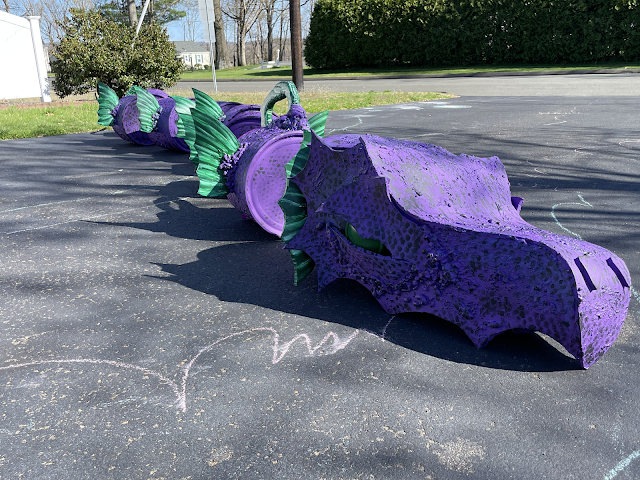
I did my best to capture the whole construction process in photographs so I'd like to take this opportunity to share with you all the journey of constructing the "Gloweed Leviathan" that we affectionately dubbed Long Barney. Team Sea Serpent (myself, Jen, Lani, Nataliya, and Nick) truly enjoyed this entire process and are very proud of the result.


A picture from Echoes of Ragnarok. These cardboard barrels were purchased with the idea that they would be a tree trunk for our event and the body segments for the sea serpent afterwads.


The barrels are cut in half, the internal structure is the "T" made out of 1" PVC. The pipe sticking out the sides is a specific engineering choice. Expanding foam is being used as the "glue".

All the barrels are now set up with the internal supports. The first fin is attached. The EVA foam that makes up the fin has a tab cut into it that is inserted into the PVC pipe on the side and filled with expanding foam in and around to cement them in place.

The initial shape of the head made of three panels of EVA foam. It was Nataliya's design and execution that gave this head a very organic shape.


Fins on both sides of the tubes are now in place.

Another view of the fins on, in the back is the tail piece that has different shaped fins just for the aesthetic.

The head is now attached to the cardboard tube with some extra panels to complete the shape and hold it in place. There is a skeleton of pool noodles in there as well to hold it together and keep it from collapsing.

The dorsal fin section, the tail, and the tail-tube with its elongated fins. Here you can see the extra texture that was created out of expanding foam to create a more realistic looking skin.


More views of the fin attachment and skin texture.


Nostrils added to help detail the head.


Spraying plasti-dip on the EVA foam fins to make them more resilient and hold paint better.


The plasti-dipped head showing the added eye sockets and skin texture.

The eyes were tap lights that were painted green.


A base-coat of latex (purple) and acrylic (green) paint goes on the body. Purple and green are the official glow weed colors but it was at this point that we starting calling the monster "Barney" because... well... purple and green.

The base coat of purple on the head.

The detail work on the fins and scales starts to get painted on.

More views of the details as they get painted in.

The lined up pieces really start to show how the serpent will come together.

Detail on the tail

Cloth added to the backs of the tubes to hide the internal structure but still allow access.

Final detail on the head.

Checking out the LED lights that were glued into many parts of the body.

All done! All the parts stacked up.

The kids were certainly impressed.


Various views of the completed Long Barney

It all just barely fit in the car after a few different attempts at Tetris-ing it in.


And here is the moment when Long Barney appears for the first time, causing exactly the amount of chaos we hoped that we would see. Enjoy!


Tuesday, May 10, 2022

The War Camp - Divine Intervention II

by Jason "Aeston" Rosa

From the event's rules document: 

"It is the Friday night before you launch a full scale invasion on the occupied lands of Darkvale. Many of you have gathered here tonight wondering how to best ready yourselves for the task. Many others will arrive tomorrow morning expecting to make best use of the preparations you will make. Now is not a time to be idle.

In order to give your army the best possible chance of success, this beachhead into Darkvale must transform into the best fortification possible. A safe area to store arms and armor. A firm anchor to secure the supply lines. A place for leadership to plan and organize. Creating that place, that war camp, is your task this evening."

------------

A decade ago, during the last time I was a part of throwing an event to retake Darkvale, I designed the Friday night content of the players building a war camp and that war camp factoring into a large-scale set of mechanics for the weekend that managed various aspects of the war. In that camp players had to physically bring building materials and construct, in the area of the fire pit at Abe's land, a couple dozen structures that each had specific criteria and purposes. I remember it being one of my favorite parts of the event. There was so much anticipation in the air, so much purposeful labor. I felt like the players were taking ownership of their own potential for success.

I thought a lot about how to recreate that magic, but how to do it in way that allowed more people to get involved and create something with more depth, more of its own life. Rhiassa has been very successful over the years with incorporating an "arts and crafts" component into our questing events, so the idea of creating the war camp as a scale model was a natural conclusion I was able to come to having ten years more experience than the last time I wrote rules for these kinds of mechanics.

I had hoped, in the weeks leading to the event, that the players would not only embrace this mechanic in terms of the advantages that the war camp would grant them, but also in terms of creativity. Yes this would be labor with purpose, helping them gain powers for the battles ahead, but it could also be a labor of love - players could show off how much they cared for their deities, their heraldries, their roles as members of the army and their greater positions in the context of the entire Realms. And they could do those things by crafting buildings and other objects put together with thoughtful consideration and care.

As event holders it's not uncommon for things to go *mostly* the way we plan them in our heads. What is a little less common is when things work out exceedingly better than what we could ever hope for. When I looked at the finished war camp on Saturday morning that was the feeling that I got. It was deeply moved by how much thought and care was put into the scale model and I was immediately possessed to document it as well as possible.

Below please find the short video I made displaying and honoring the efforts of the army in building their war camp.


Ultra high resolution version: Here

For those of you who are interested, here is the rules document the players were given that governed the construction of the War Camp.


Wednesday, May 12, 2021

Core Elements of Eventholding: Foreshadowing

 Eventholding is a complex art, with many moving parts, and trying to capture them all in one article is daunting. Today I’m going to talk about foreshadowing and writing. 


Foreshadowing is a term used to describe how an author can show their audience what’s going to happen later on within the story. It’s how they tip their hand. It can be an important tool, because it allows the author to put in plot twists, and for those twists to seem like they have a place within the story. 


How much a reader likes the twist in a plot could be correlated to how much they can see the threads of that twist coming. If there is no evidence for the plot twist coming, it will likely upset your audience. If it doesn’t fit the narrative of the common stories we all know, if it just is so wildly unlikely to happen, your audience just won’t like it. On the other hand, if you’ve been tipping your hand too much, and they can see it coming at every turn, then they probably will be bored by the twist as well. You really need to find that balance, where they can’t see it coming, but once it happens, they look back and say “Oh, it was there all along, how did I miss that?”


And that’s really what foreshadowing is meant to be used for. The “it was there all along” moments. 


So how can we incorporate that into our event holding, and writing for our events?  The most common way I can think of that people foreshadow in events is through references to popular media. I can’t tell you how often I’ve been at an event and been going through a quest, and had someone realize that they were doing the plot of some show, comic, book, or anime, that they loved.


Tipping your hat to your influences, as a method of foreshadowing, can do a lot of the leg work for you. It will let the players that catch your reference know which direction you’re intending to go with your plot, and maybe even the mechanics of your encounter. For example I feel like every time we come across a door with runes around it someone says “Speak friend and enter.”


I do want to say though, that if you tip your hand too hard it can have the opposite effect, in that rather than understanding your tone and intentions, your players will just feel like you’re breaking their immersion by being too on the nose. 


Here, let me give an example of what foreshadowing with pop culture references  might look like, and you can decide if I go too far: 


It’s Monster Island 7, you were conned into a lovely cruise vacation getaway that also had the promise of adventure: going out to a forbidden part of the sea because it was full of monsters. It happens to adventurers. You know it does. Your ship has wrecked. You’ve been fighting the waves for hours, mysteriously casting your raise deads on the corpses of your friends bobbing to the surface, when a ship that mysteriously looks exactly like the one that sank, rolls on up to you. You’re rescued and safe. Ish. 


As it turns out it’s a pirate ship, and Captain Euron, a man with purple skin, white hair, and a black hula skirt, confesses that he’s in love with the Red Queen of a nearby island. He and his crew have been posing as a sea monster to stave off suitors. He promises he’ll transport you and the party to the island safely if you promise to be silent about the sea monster part, and can arrange for him to get a date with the Queen by sunrise.


Did I tip my hand too much? What was I referencing? How do you think that story should end? Let me know in the comments!


Before I end, I’d like to add a commentary on an important concept of foreshadowing. Chekhov's Gun, is the idea that if there is a gun on the wall in the first act of a story, it should be used to kill someone by the third act of the story. Applying this concept to LARP can be challenging because on the one hand, you want to give your player’s an immersive reality, and sometimes, in the real world, a cup is just a cup. However, thinking about Chekhov’s Gun when you’re decorating your dungeons, coaching your NPCs on what they should be relating to the players, and creating mechanics for your quest, can really change your perspective on what you’re writing. It speaks to relevance, and red herrings within a quest, if you want your players to get distracted by red herrings, throw in things that have no purpose but seem like they do. Personally, I don’t like this approach, it makes a clever PC feel cheated for getting distracted by something you put into the story. Red herrings happen completely on their own, you don’t need to plan for them. Rather, focus on linking up the things that matter within your quest, connect the pieces, and let your friends feel like geniuses for seeing it coming from the very first clue, that’s what foreshadowing is for. 


I look forward to being able to see you on the field, 


Keith “Saegan” Cronyn


Tuesday, May 4, 2021

Core Elements of Eventholding: The Gardener and the Architect

 Event holding is a complex art. It has a lot of moving parts, and capturing all of them in a single article would be pretty daunting. So I would rather break it down into smaller chunks and parse it out a little better. Today I’m going to talk a little bit about writing. 


I’ve spent a good amount of the time of my eventholding career writing plot for Blackwood events. Invariably standing in front of the whiteboard at the Blackwood crafting studio, muttering to myself as I try to untangle my thoughts in a way that would be functional for the rest of the team. When really, I’m just trying to outline the course of the event for them. 


So for me, my instinct says I should be writing like an architect for events. Architects, or planners, plotters, or outliners; are people that lay out the course of the event in detailed outlines before getting into the gritty details of what’s happening. Some people fall into this category very comfortably. They can outline with finite detail, and allow themselves to map out an event, and it makes sense for them. 


Personally, I have a harder time with architecture, as I said.


The reason that it can be a challenge for me is because I am more comfortable writing in a way that might be described as “gardening” or “pantsing”. Gardening, coined by George R. R. Martin, refers to a writer who writes the bulk of their work as they go. Letting it sort of blossom into the piece that it’s meant to be, and then painstakingly editing it after. 


The problem with that idea is that you cannot edit after a LARP event. Not in a way that feels good for a story for anyone anyway. People lived the experience you provided for them, and changing it after the fact generally doesn’t feel good. Another problem is that to execute a gardening style of eventholding within the Realms, is that you’d basically be winging it from encounter to encounter. 


Which is why when I stand in front of the whiteboard, I might just be  there muttering to myself. To me it feels inorganic. I want to garden. The organic, or gardening portion of the event comes from the player’s actions themselves. A novelist controls the actions of their characters, an event holder has to compensate for that lack of control with more planning, in order to achieve the same level of storytelling. 


I think that this is actually a spectrum, and people can probably lean in either direction and be effective. At the same time I think it might be helpful to take a second to recognize the benefits of both, so that if you come across a gardener or architect in the eventholding wilds, you can work with them to your mutual benefit, rather than your ultimate frustration. 


Gardeners, they have a reactionary style towards storytelling. They are really great at taking the pieces they have in front of them, and working them together and making a story mesh. I would say a gardener would be good, with no advance notice, taking a first event newbie’s backstory and sliding it seamlessly into the plot. 


How do you help a gardener with their eventholding? Check in with them frequently. Tell them about the parts of the plot they didn’t have eyes on. Tell them what you think the players need more of, or what  to adjust to make the event more fun. A gardener leans into the real time changes more easily. 


What are the dangers of leaning too far into gardening? If you’re lazy it might be tempting to consider yourself a gardener. To just sort of leave massive holes in your plot and make it up as you go along. That’s not writing. That’s the lack of writing. Even someone that leans completely in the direction of gardening should have some islands of plot where they know where the adventure is going. Some background kernels of information that gives their characters rich intentions and personalities. For me, I often know what the goals of my NPCs are, so I can adjust their course as  player actions change what some of those goals look like. To have no intent, no background, no overarching idea, no goals at all is to be a true improviser, and results may vary but are more likely to have poor results. 


Architects are the other side. They plan everything out. They know what they want the entrance to a room of a dungeon to look like. They have detailed stats for their monsters and puzzles. They have prop lists. You know, all the things that make you feel organized. An architect is really good at making every player’s role have a purpose mechanically within the game. 


How can you help an architect with their eventholding? Read their plan. Ask the questions you need to in advance, to help them clarify their plan. Keep things neat and organized. And resolve the surprises that come up in a way that keeps things flowing within the context of the plan, independently where possible. 


What are the dangers of leaning into architecture too far? Well if you plan everything out, you might feel inclined to rigidly expect things to play out in a certain way. It can be very natural to have an expectation for how an encounter should end, and when someone does something to alter that, that might be pretty frustrating. Architects might come off as too controlling, and almost sort of forget that LARPing in its very nature is a communal storytelling exercise. It’s collaborative. If there is no collaboration, then you’re not really holding a larp any more. 


Recognizing what kind of writer you are is important. You can lean into your strengths, while also incorporating the strengths of other writers around you to shore up your weaknesses. 


So what kind of writer are you? Are you a gardener? An architect? Or somewhere in between?


I look forward to your answers,


and when I can see you on the field,


Keith “Saegan” Cronyn 


Tuesday, April 27, 2021

Core Elements of Eventholding: Editing

Eventholding is a complex art. It has a lot of moving parts and capturing them all in one article would be pretty daunting. So today I’ll rant about editing. 


I hate it. The end. 


Okay, so that’s not really fair to say. The bit about that being the end. I do factually hate editing. But it’s an important part of writing, and also event holding. 


If you want to create an event that flows well, that tells a story, that leads to epiphanies, and has depth, you’re going to have to look at it more than once. You’re going to need to have someone else look at your work and tell you: “Hey man, you know, this looks like the players are only fighting for 12 hours. That might be epic for some players for sure, but maybe some content for your other guys too?”


And it’s also important for the mechanics we play by. I’m almost positive I’ve NPC’d at events where where the notes for the night quest were “and the  PCs solve the puzzle and  get the ( plot device.)”  As someone who was just tasked with helping to run the night quest, that’s sort of a daunting and ambiguous idea. What puzzle? Did you have a prop for it? Where is this being held? Sometimes while writing content your brain will just sort of fill the gap for you, it will insert a bridge between point A and point C in the plot, without actually working out what point B is. You can read over that point half a dozen times, and not even see it. To that end, having a second set of eyes look over your content, to tell you what’s missing, can be crucial. I think rolling with it, and course correcting your event as it goes is an important skill, and I don’t want to take away from that skill, in the same way you probably don’t always want to have to fix the engine of your car, you probably shouldn’t want to have to fix your plot. Sometimes it should run smoothly without having to roll with it.


So yes, it’s important to edit your written content before running it. But can you edit your content on the fly as well? You can plan ahead, to sort of edit your writing content to tweak the flow of your event day of, and make a more cohesive story for your players. And also to tweak for time constraints. I think it’s a good strategy, and it just takes a smidge more planning and forethought.  


 For the purposes of this strategy, you should consider these three things when planning your encounter 1) The time the encounter is intended to take. 2)What it adds to the plot. 3) What kind of player the content serves. 


  1. The time the encounter is intended to take

The time an encounter takes can be hard to judge. It takes practice, and even with practice  it’s always possible to under- or overestimate your timing. A prime example that I have seen over the years is solving puzzles in the dark. The puzzle seems easy enough in your living room when you test it in advance, and originally you’d planned to get that content out during the daylight, but it just didn’t end up happening. So you throw it into the night quest, and bam. The players take an hour to solve a 10 minute puzzle. It just happens. You learn to think about those angles. You make different mistakes. You learn some more. Time is hard to judge, but it’s important, because every quest must end. Whether it’s because the park is closing, or you only rented the area for a certain amount of time, or its Monday and PCs have to work. Timing is essential to throwing a good quest, so it’s something you always have to be thinking about when planning your content.


  1. What the encounter adds to the plot

Encounters should have a meaning within the context of the relevant plot. I’m not a big fan of loose ends, or story strands that are left without any closure. Events have time constraints, so your story should have parameters on what happens within it. Parameters don’t have to be strong, you could write an encounter with low importance, that just gives tidbits of world building, and is fun. That should still become relevant information at some point. But it doesn’t need to be immediately relevant. 


I like to rank importance in tiers. Tier A: being immediately important and relevant to the plot of the event day. Tier B: being relevant to the plot, and perhaps having more levels of foreshadowing for future events, with maybe a nod to current mechanics to reinforce an idea introduced in a Tier A encounter. And then Tier C content: this content is more relevant for world building, future events and side content. it’s just there to make it so that I can balance out the content for the types of players I have. 


  1. What kind of player the content serves

The way I think about player types constantly evolves as play styles evolve within our game’s culture, but here are some example play styles and content styles to consider: Fighting, Puzzles, Roleplay, Physical Challenges, and Theater.


 Fighting is fighting. I’m a fighter myself, and I like the rush of a challenging but fair fight. I think there are many people who play the game for the challenge of fighting. 


Puzzles are a little bit more broad. It could be a mechanical puzzle, a word puzzle, a riddle, or something else. 


Roleplay encounters should be where the meat of your exposition or direct storytelling happen. The drama. 


Physical challenges are anything physical that isn’t fighting. I consider physical challenges as it’s own thing because over the years, it has become apparent that fighting isn’t the only type of exertion people enjoy in the game. Sometimes a foot race adds to the story. Burpees never add to the story. Okay, maybe sometimes. You can do them though, not me. Obstacle courses are great options for physical challenges too. 

Theater can kind of overlap with roleplay, in some ways, but it’s a little different. While roleplay is a content piece that has interaction between multiple parties to tell a story, like Vlad the Vicious, and Markus the Wise, a theater piece is when the PCs use their creativity to perform something. For example giving them a silver chalice with ancient rites that must be performed under the moon but only giving limited parameters on what those are. In that way, the players are able to be creative in what the ritual looks like.


So you’ve broken your encounters down into these distinctions. How is that helpful? Say your A tier encounter in the first act of your quest has gone on for an entire hour longer than you intended on a 5 hour quest. What do you do? Cut all your C content. Bye. Say your next A tier encounter goes over too, but you only have A and B tier stuff left. Now you combine content. Add the relevant parts from your B tier encounter into your A tier encounters. Make them stronger and more interesting by mixing components from a Theater Encounter with a Combat encounter. Or just make it more challenging by combining two important Combat encounters into one. Its okay to make those edits behind the scenes. And it’s not too hard if you’ve planned it in advance. If you consider what to look for, and you communicate with your crew. 


If you do it right, your players won’t even know it happened at all. 


Those are my thoughts on editing before and during events to make your events better. 


Do you have any examples where editing could have helped make a quest better?


I look forward to your answers and seeing you on the field, also special thanks to Danny and Jen for editing this article for me. 


Keith “Saegan” Cronyn


Wednesday, April 22, 2020

5-Minute Encounter Builder


Writing encounters can be hard. Over my years of experience I’ve broken down encounters into two basic components, and subcategories beneath that. From there I construct my encounters efficiently and to the goals of my plot.The goal of this article is to break down that process so that the community at large may apply it to their own encounter creating processes.

First the two basic components to every encounter are flavor and mechanics.

Flavor is the story of the encounter. It’s the skin. The components that let it fit into our fantasy world. The flavor is the fact that the NPCs are goblins, or that your players are wandering into a dark cave. The flavor matters for the story, it matters for consistency within your content, and it matters in the sense that your players wouldn’t feel satisfied that they were playing in a fantasy world without it. Flavor creates immersion.

In the same way that Flavor creates immersion, mechanics make it a game. Mechanics are the actions that players need to complete in order to be successful in the encounter. It’s the win lose conditions. It’s the rules that make the scene turn. They might be as simple as “win the fight” or “solve the puzzle” or they might be a more complicated series of actions that come together to form one greater action. But the mechanics make the encounter a game for the players to play.

Flavor can be broken down into three interrelated components. The setting, the cast, and the dramatic question. The setting simply put is where the encounter takes place in terms of the story. The cast is just what the NPCs are made up of. Generally, they cast and the setting should match up. For example, it might make sense to find Goblins in the woods. The dramatic question, is the motive the players have within the story, that makes them want use the mechanics to push the plot forward. For example, if the cast and the setting don’t match up, like say the setting is under water, and the cast is still Goblins, your question might be: Why the heck are goblins surviving underwater?

Mechanics on the other hand can be broken down by type of mechanic and win/ lose condition. By type of mechanic I mean the type of encounter. Usually I break down my mechanical encounters by the terms: Combat encounter, Physical Challenge, Role Play Encounter, and Puzzle/Craft encounter. Personally when I run a quest, I try to intermingle the types of encounters I have so that my players can all enjoy themselves for the various reasons they like to play.

Now that you have a break down on encounters why don’t you try breaking down some of your favorite movie scenes? What’s the setting? Who are the NPCs? What’s the dramatic question? What type of encounter is it? What are the win and loss conditions?

Having trouble thinking of some scenes to break down? How about Indiana Jones’ famous escape from the Temple of Doom? Harry Potter’s Wizard Chess Scene? Goonies’ Skeleton Organ Scene?

Once you’ve answered the questions, trying reskinning the scenes to fit your plot. How might that Indiana Jones’ scene look with Bois, for example?

Give your favorite creations in the comments!

I’ll see you on the field,

Keith “Saegan” Cronyn


Wednesday, June 5, 2019

On Questing at ToC 26: An Interview

 William "RuBarb" Moore, one of the event-holders for ToC 26 who ran the questing portions of the event, was interviewed by Jason "Aeston" Rosa on Saturday at ToC 26 about the night quests planned for the weekend. Responses have been lightly edited for clarity.

*****

Q: Alright, can you start by describing the plot of the night quests this weekend for us?

So, the plot of this one is people are travelling into different worlds. It’s kind of based off the movie Stargate a little bit, there is a god that is coming down and taking these villagers and turning them into his army, and they now just recently got access to the Realms, and now the Realms is going in and trying to defeat the god currently.


Q: So throwing a night quest for a very large population of people like you get at Tournies must be a challenge. What are the ways that you deal with that particular challenge?

Well, actually it hasn’t been that bad for the most part. Usually with Demonic Invasion I split it up into three different groups. Here it was a little challenging last night, we had a large group coming out. But it’s just like a combination of having the puzzles that are out there, having some combat out there, and then sort of even changing the dynamics of the actual combat, so throwing in new creatures that have different effects so then the people that weren’t involved before now start getting involved. And then putting some puzzles and riddles and things like that out there.


Q: Are there any particular members of your team that you would describe as incredibly valuable to you? What do they do that makes your job easier?

Josh and Craig, I relied on them very heavily last night to sort of take charge and learn the plot for the night. And they took it and ran the NPCs, we didn’t make any changes to the stats or anything like that all night so I think it ran pretty well. I relied heavily on them because I was with the PCs being a PC/NPC for the night and we barely talked, they ran it very well and I was very happy to have them on my team.


Q: Are there any props or special effects you’re especially proud of for this weekend?
The gate is the biggest one that I’ve spent hundreds of hours into, it lights up with LEDs and everything like that. There’s the pyramid puzzle, that was cool, that was released at Feast of Creathorne, which has ley lines and they all interconnect, it’s like thirteen different pieces that all create a pyramid at the end. I spent a lot of time building props in general, there are scrolls out there that they need to decipher with different runes and different symbols and stuff like that. But yeah, probably the gate is the most time-consuming and impressive one.


Q: And last question, why do you think that this event is a particularly great place to throw questing?

Just the people. Honestly, I think, you just have a different dynamic of all the different groups around here and I think it’s interesting to see how people really react and change and bring their mindset into the situation. So like, someone has an idea and then another one bounces off another idea and then they figure it out together, and I think that’s really kind of what I do it for, I do it to entertain people and have people have a good time, so I think that’s what makes the event special for me.


Photo by Jason Rosa

Photo by Jason Rosa


Tuesday, April 3, 2018

Food and Feasting in the Realms

Food and Feasting in the Realms

by Melissa "Aymise" Metzger

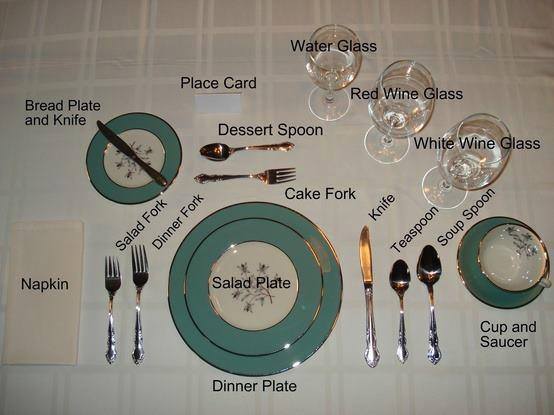
Providing food at events makes sense because everyone needs to eat, doing so with friends is generally a pleasurable experience, and hungry adventurers can be downright grumpy.  So it is no surprise food is an important part of Realms events. Ranging from salty snacks on the side of a quest, to multi-course formal feasts, and many levels in between.  Feasts in particular are a fantastic opportunity to get together with friends and socialize over delicious food with a good deal of roleplay thrown in.  They are also a great opportunity to show off the cooking skills of Feastocrats, introduce recipe ideas and give something back to the community.

For some people, however, the activities surrounding food can be a stressful experience. Current trends in society show more and more people are contracting allergies and/or other medical ailments which can cause managing their food to be a struggle. In addition, there are also those whose beliefs require them to eat in a certain manner.  Naturally, as our community grows and becomes more diverse, the food restrictions do as well.  For these Event Goers, eating can become a real challenge.  This challenge can also impact  Feastocrats as well, especially when expectations are not clearly defined.  Sometimes the communications between Event Goers and Feastocrats can fall flat, which leaves both sides feeling frustrated in the end.

In our community, anyone can throw an event.  By this tradition, anyone who can secure a ‘kitchen’ can throw a feast.  Many Feastocrats in the Realms are cooking hobbyists, who have no formal commercial kitchen or food safety training. They just want to do something nice for their friends and community.  There is nothing wrong with this style, as it has produced a huge array of experiences and competition, bettering the feasting experience for all.  In this free form environment, however, communication is key to create a safe food experience for all.

Adding another layer of complexity, the kitchens used in the Realms are rented spaces.  As Feastocrats only have the ingredients they bring with them, and limited time and equipment availability in these spaces, many of them opt to prepare parts of dishes in advance of the event.  This can mean some or all of the food being served at an event is already prepared well before the event starts.  In these cases, no last-minute changes can be made, even if a Feastocrat would normally want to honor a last-minute dietary restriction.

How can the community help improve the experience for all?

If you are a non-affected player:
You can best serve the community by respecting the space at a dayboard. Try to keep things clean as you serve yourself, and minimize mixing food between serving plates or using serving utensils on other dishes, to keep things safe for others.  If you do see any issues, reporting them to the staff promptly is appreciated.

As a player affected by a dietary restriction: 
It is your job to be proactive about your health and/or beliefs.  Pre-registering your dietary restriction with the Feastocrat/Event Holder as soon as possible is a must; it does not matter if your restriction is common, or you believe you are going to be the twelfth vegetarian there. Be aware that not all dietary restrictions can be accommodated by every event staff, but the more time the event staff has to plan around your needs, the better they can serve you, and the safer your experience can be.  Personally, I feel two weeks is the acceptable minimum, with earlier obviously being better.  If all else fails, remember any time before the event is always better than while in the buffet line.  You can facilitate this by saving your dietary restriction in your character profile on RealmsNet, so it automatically sends every time. For times when you do not know for sure you can attend in advance, you can always email the Feastocrat to give them a head's up about your situation.

If you do need to ask clarifying questions at the feast, be polite and be patient. Not all servers will have all the information you seek, and sometimes the Feastocrat is dealing with matters a bit more urgent (like a literal fire in the kitchen).  I know from personal experience it can suck sitting there staring at your plate while everyone around you chows down, but know you are not being ignored and your answer is still a priority to them.

Be specific and realistic about your needs and the extent of your restriction.  An allergy could mean you cannot be in the same room as an ingredient, or can be fine as long as you do not eat beyond a certain quantity.  An intolerance could mean you just need to know to have Lactaid on you, or could put you in crippling pain for a week.  Clear communication is key to ensure you and your Feastocrat have the same expectations for your experience.

Feastocrats and kitchen staff do not get off easy here either.  

As a Feastocrat: 
It is your place to set registration expectations in the event announcements. It is on you to follow up on any restrictions you feel you cannot accommodate and be realistic to the players about what you can and cannot do.  It is also on you to follow through with your agreed upon accommodations. This means keeping a clean kitchen, briefing your kitchen staff, monitoring your staff, and above all else, treating each dietary restriction with the same level of care and respect, regardless of how trivial or serious a restriction may seem.

If you are a kitchen helper:
Always wash your hands, tools and work surfaces.  If you are preparing items for different dishes, wash your equipment and space between dishes.  Even if the Feastocrat gives you a list of all ingredients of concern, they may get surprised by another one mid-feast, and then it is that much harder to work through what could have touched what earlier in the day. Also, accidents happen and you should immediately let the Feastocrat know if any ingredient ends up where it should not have so they can assess the impact and inform the appropriate parties.


Those affected by dietary restrictions know this is a battle which is waged in real life every day, not just in the Realms. It is our duty as a community to support each other in these efforts to ensure no one gets sick and everyone can enjoy our rich feasting traditions!

Happy Feasting!

Melissa Metzger
Aymisara Cursoraventis Filiamterrae
Guild Mistress of the Order of the Spoon

Wednesday, May 10, 2017

My First Time


My First Time
(doing a Feast)

By Janna Oakfellow-Pushee


“Mama, whatcha d-doin’?”
“Working on some history for the Ivory Library, baby.”
“Why?”
“Because history’s important, yo.  It’s a way to learn your roots, where you started, and sometimes where mistakes were made and how to become a better person from that.”
“Oh. That sounds hard.”
“It’s a lot more complicated than what I just said, but yes, history can be hard.  Right now I’m working on things in order to get ready for the upcoming feast.”
“Mama, what’s a feast?”
“A place where a great many people sit down and eat lots of food, and play or sing or tell stories, or compete in games, or a whole bunch of other stuff.”
“Like Game Night?”
“Sort of, DanDan.”
“Mama, have you ever d-did… do a feast?”
“Yeah, baby, look here.”  *pulls up the Archives, begins to read out loud the reviews*
“...Mama, a lot of people d-did not like it?”
“No, baby, a lot of people were not fond of it.”
“D-did you… so, did you make the food to make them not like it?”
“Nah, that wasn’t the problem; food was great, I thought. It was--”
“Well, how was it your feast if you did-nit not make the food?”
“It’s called ‘Event Holding’. I--”
“So, you never d-did food for the feast thing, Mama?”
“...no, I haven’t.”
“Why?”

...and then Danielle went off to play for while, and I was left with the swirling thoughts of “Why?”
  • Because I don’t want to give folks food poisoning.
  • Because I don’t want any food waste.
  • Because I don’t want to waste money.
  • Because I don’t want to fail.
  • Because I’m scared.

That was the biggest thing, actually.  Being scared.  All the above thoughts were valid, but in general, FEAR was the top rank of ‘a reason NOT to’.  There’s an Order of the Spoon, and while at the time I knew that the current feast folk I could think of were a part of the Order in some way (a Master, a Journeyman, or an Apprentice), I also thought that if one wasn’t a part of the Order, or didn’t wish to be, that one could not pull off a feast, let alone a decent one.

Then I thought of my squire-ly task from Sir Vawn Coupant, a.k.a. David Hayden, a Knight of the Realms and of Eagle’s Rook: it was all about conflict.  Here’s a definition:

con·flict
noun: conflict; plural noun: conflicts
ˈkänˌflikt/
1.
a serious disagreement or argument, typically a protracted one.
"the eternal conflict between the sexes"
synonyms:    dispute, quarrel, squabble, disagreement, dissension, clash; More
antonyms:    agreement
a prolonged armed struggle.
"overseas conflicts"
synonyms:    war, campaign, battle, fighting, (armed) confrontation, engagement, encounter, struggle, hostilities; More
antonyms:    peace
an incompatibility between two or more opinions, principles, or interests.
"there was a conflict between his business and domestic life"
synonyms:    clash, incompatibility, incongruity, friction; More
antonyms:    harmony
PSYCHOLOGY
a condition in which a person experiences a clash of opposing wishes or needs.
verb
verb: conflict; 3rd person present: conflicts; past tense: conflicted; past participle: conflicted; gerund or present participle: conflicting
kənˈflikt,ˈkänˌflikt/
1.
be incompatible or at variance; clash.
"parents' and children's interests sometimes conflict"
synonyms:    clash, be incompatible, vary, be at odds, be in conflict, differ, diverge, disagree, contrast, collide More
having or showing confused and mutually inconsistent feelings.
adjective: conflicted

"my feelings are so conflicted that I hardly know how to answer"
IMG_1055.JPG
....well, snickerdoodles

In this particular case, I was in conflict with my fears and reasons not to do a feast.  I could hardly tell Dani-Danger, though, that I had tried and done everything in the Realms, if I hadn’t actually tried this.

I don’t even know if this is possible. I mean, I could probably get the same site from last year from my father, if I asked for a date.  But what about the country (I was now in Eagle’s Rook) and our lack of numbers?  What about the plot from last year?  What if nobody comes?  How can I afford this?  What would I have to do in the first place if I’m just doing the food?  And am I supposed to just do food if I’m the Feast-o-Crat(because I had seen plenty of times where a Feast-o-Crat had a lot more than just food to do (see example: Matthew Brenner), and times where the feast is more than enough to do (see example: Leilani Grayson))?

So, with all these questions on my mind, I decided to quell a few by asking for a listening ear from the two wisest folks I had in my life:


And after I was off the phone with them, I had the beginnings of menu ideas, dates for the site in Scotland, CT, and leads on whom to ask for help.  I was also reminded that if I was going to do this, that I should probably call said Knight Commander and talk to him about it. It was, after all, going to have the country’s name attached to the event.

Huh.  Guess I could attempt to do a feast thing, after all?  But what kind of feast?  And how much should I be involved in the whole thing, versus just the food?  What if I give control away, delegate?  What do I need to stay on top of?  What would I have to do myself, specifically?  Could we pay for this whole thing?  What else am I missing?

whereeverythinggoes.jpg
And thus, it began. Stay tuned for the next installment.