Showing posts with label Knights & Squires. Show all posts

Saturday, January 4, 2025

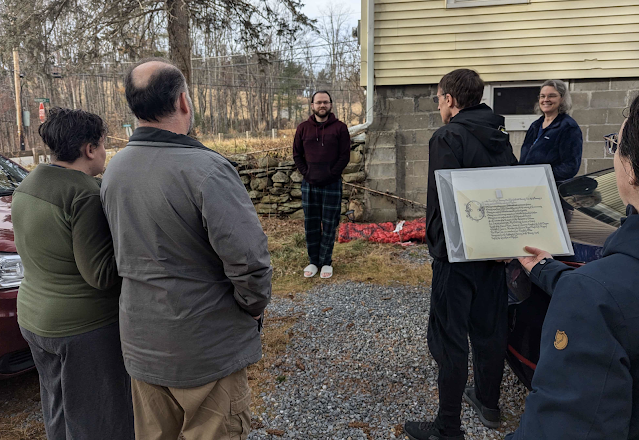
A Very Special Announcement - Writ of Eques Fieri


The Writ beautifully penned by Karen Veale

The text on the above scroll reads as follows:

On this day of the 4th of January, One Thousand and Twenty Five the following is hereby proclaimed to the entirety of the Realms.

Owing to abounding years of dedicated and meritorious service

Owing to persisting, faithful stewardship towards the entirety of the community

Owing to a ceaseless dedication towards personal growth

Owing to an unwavering commitment towards the franchise of others

Owing to an ever present attitude of selflessness and devotion

It is the intention of the KNIGHTS OF THE REALMS to welcome SIR SAKARIASVAFNIR “SAKA” REDWING Knight of the Eternal Flame, Avatar of Chimeron, Knight of the Sable Dragon, Warlord of Chimeron, Member of the Chimeron Royal House, First Mage of Rua Thar Cinn, as a member of our Knightly Order during court on the Eighteenth of January, One Thousand and Twenty Five at the Twenty Sixth Feast of the Leviathan in Rhiassa. 

...


The Knights of Realms cordially and enthusiastically invite the entire community to celebrate the recognition of Patrick “Saka” Bobell as a fellow knight and his admission into the order.

Beginning with our knighting pervious to this one the Knights of the Realms have begun this new tradition of announcing our intention to knight Pat in advance of the event at which we will do so.  Rather than maintain a veil of secrecy, we feel it is better that those who love, admire, and support Pat can be there to witness his inclusion within the order. At a small private ceremony earlier today, Pat was surprised with the above announcement and scroll.

We hope you will join us at Feast of the Leviathan this year in honoring Pat’s many years of tireless service to our community.


Sunday, January 1, 2023

A Very Special Announcement - Writ of Eques Fieri


The text on the plaque above reads as follows:

Writ of Eques Fieri

On this day of the First of January, One Thousand and Twenty Three the following is herby proclaimed to the entirety of the Realms.

Owing to abounding years of dedicated and meritorious service

Owing to persisting, faithful stewardship towards the entirety of the community

Owing to a ceaseless dedication towards personal growth

Owing to a unwavering commitment towards the franchise of others

Owing to an ever present attitude of selflessness and devotion

It is the intention of the Knights of the Realms to welcome Sir Tao Ya Kang Duke of Blackwood, Lord of Clontarf, Knight of the Eternal Flame, Knight of Blackwood, Knight of Chaos, High Priest of Edaonae, Champion of Tyche, as a member of our Knightly Order during court on the Fourteenth of January, One Thousand and Twenty Three at The Twenty Fourth Feast of the Leviathan in Rhiassa. 

...

The Knights of Realms cordially and enthusiastically invite the entire community to celebrate the recognition of James Murphy as a fellow knight and his admission into the order.

Announcing our intent to both James and the community at large is a break in tradition. Rather than maintain a veil of secrecy, we feel it is better that those who love, admire, and support James can be there to witness his inclusion within the order. At a small private ceremony earlier today, James was surprised with the above announcement and plaque.

We hope you will join us at Feast of the Leviathan this year in honoring James' many years of tireless service to our community.


Friday, September 24, 2021

A Squire’s Challenge: By Pilpus

A Squire’s Challenge


I began my journey in the Realms as a scared kid who didn't know who he was or what would become of him.  In my comparatively short lifetime I've suffered many cold winters and cruel summers alike, but who was once an illiterate farm boy writes this account to tell you what it means to find a home, or at least what it means to me.


Amazing experiences are few and far between, and amazing people even rarer.  In the last decade, I have been graced with a plethora of both.  Being a part of Blackwood, even as a petitioner, has been chief among the blessings I count every night before I rest my head. When I received my shield I was barely a man, in age and words alone, but the people of Blackwood put in the effort to respect me anyways, and treated my happiness, well being, and progress as paramount, so I made sure to repay their kindness with the effort I felt it was due.  When that loyalty and time spent made me a Squire I was elated.  To know that the Knights I looked up to considered me worthy of special trainings and their sage advice brought me a joy even I hadn't anticipated.


Like many other people in this world, I'd worked countless hours  towards a variety of goals, and it was in that moment that Sir Mathias wrapped his belt around me that I suddenly felt something I'd never felt before- Acknowledgement.  


Acknowledgement seems similar to respect in concept but in my brain, they exist separately.  There are people and things that you respect but never feel the need to say aloud or expound upon.  Respect is a given, but Acknowledgement is a choice.  Having Acknowledged many other people myself since then, the distinction is that to Acknowledge someone, you are moved  deeply enough that the respect you harbor has transcended the innate expectation.  The fact that someone who looms so large in our world looked at my relatively miniscule actions and saw something worth supporting and taking a stand for moves me to this day, and fueled me in every endeavor beyond then. 


To be a Squire is to pay the debt of gratitude to those who care enough to pluck you from the metaphorical rabble and pour their time, energy, and resources into helping you build the foundation of your very being in many ways.  For me, it's my sworn duty to prove that I am worth that investment.  Making connections, fighting wars, educating oneself; everything one does from the moment someone champions them in this way is in some way a service to the people who you one day might rank among.  


It becomes your duty to become not what the order or your Knight wants, but what the order needs.  A squire is one whose duty is to reciprocate trust with innovation.  A knighthood that needs fresh blood is not a knighthood, but a club, so as a Squire it is your job to become something unique and useful.  Whether the knights you service need craft training, insight, or strength, to truly be someone's squire is to support them the way they support you through any weather that may confront you as a team, and face it head on.  Being a squire is not only to follow your Knight into battle, but forge on where they cannot, or have never been before.


It’s on those path’s never walked that one’s final task starts, and it’s in this unspoken assignment that one defines who they are, not just as a knight but as a person.  It’s on this road that one must realize that the reason this whole process begins with Acknowledgement is because this process ends, or more accurately continues on forever, in setting an example.  Attention is called to you in the beginning because from that moment forth you are expected to be worthy of having Attention on you at all times.  And that is why you must learn, so that the others walking behind you may do the same.


My last action as a Squire was fastening the Knight Commander's Gauntlets to my own knight’s wrist.  I was blessed enough to watch him rise to command two different cohorts of Knights in my time as his squire, and I've seen him win victories and suffer hardships as he was gracious enough to let me stand behind him.  We've fought alongside wolves, treated with Roawns (both metaphoric and literal), drank with demons, and together battled the very gods themselves in some cases.  I've walked in the footsteps of a few gallant heroes and far more morally gray men with good heads on their shoulders, but without taking the weight from each of the rest of those steps, I would not be half the man I am now without Sir Mathias' love and guidance.


My knight has always told me that of the belts he wears, His Knights of Blackwood Belt is not only his most treasured but his most important and I'm fortunate to echo that statement.  In becoming a Knight I have been so deeply moved by the notion that the pillars who hold the nation I love on their shoulders have asked me to stand with them, but even as a belt I get to call my own is fastened to my waist, I tell the Realms to know that I plan to be proving my worthiness of this  leather until my bones are ash in the soil.  I entered that feast hall a battletorn, soulless husk but I left proudly bearing the future of our order and nation on my shoulders and around my waist and I've truly never been more excited for what comes next.


For King and Country, and For the Realms.

Sir Pilpus Jainrose

Knight of Blackwood

Steward of Eroewan

Friday, January 30, 2015

My Two Regrets Squiring- by Andrew "Lysis" Adams

Many years ago, my character Lysis, was Knighted into the Knights of the Sable Dragon. I was squired for about 2 years before finally being knighted at a Feast of Blackwood.  To me, the Knighting had little to do with mentoring.  My Knight and I had talked a bit about it, and he felt that I was worthy of being a Knight. The only task he gave me, that I can remember, was to go around and challenge 10 Knights.  The Knights got to choose the competition. This was good because it got my name out there a bit. But that was all.

I vowed that if I ever took a squire, it would be different.  I actually started doing some reading on the traditional duties of a squire. It wasn’t all just cleaning armor and helping your Knight prepare for battle.  It was combat training, etiquette, and mentoring as well.

A year later, I did find a young player that was keen to get better, in the game. He would come to our weekly practices every week, and was eager to learn all he could.  He was about 10 years younger than I, still in high school and a martial artist as well.  I saw much potential.  I eventually squired him and gave him his first task.  Write an essay.  Topic: HIS definition of Honor, Courage, Valor and Bravery. It must be a minimum of 1.5 pages.  But no wrong answers, really, since it is his opinion.  The next step was to bring it to 5 different Knights of the Realms or Eternal Flame, ask them to read it, and then discuss with them their thoughts on it.  Lastly, it would be to discuss with him, if his definitions had changed. Then ask if he wanted to rewrite it.  The point of the task was twofold.  1) Get him thinking about these ideas and see how they vary from person to person and 2) introduce him to KoR and KoEF so that not only would he know them, but that THEY would know who he is. I expected the initial essay to take a month or so, and then a few months of discussion with other Knights.

The first draft took a year. But, I finally got it. It was laden with spelling mistakes and tons of grammatical errors.  We sat and discussed it.  He knew it wasn’t the quality that I wanted. I explained the next portion (showing it to others) and asked if it was the quality he wanted to show.  He agreed to try again and to do a better job. This is where my first regret takes place.  I knew in my head what he should have done.  I knew he was bad at spelling and grammar.  I knew that he could have easily taken it to his English teacher at school and asked for some feedback.  But I didn’t say anything.  I didn’t help guide him in any way. I let him flounder and feel bad that he did a bad job, and that it wasn’t good enough.

My second regret came about via an IC decision that made.  Let me explain.

At the time, I was a member of the Crystal Hall, which at that time was just a school.  I taught fighting, and was the schools chief combat trainer.  The Headmaster of the school was Xavier Cardigan (Dan Rodriguez), who was a priest of the Elven God, Corellon Larethian.  During an event, Corellon materialized and asked Xavier to start a new Knighthood, the Knights of the Crystal Hall. Corellon also asked that I be the first Knight.  IC, Lysis couldn’t believe in being a Knight of two orders.  It would be like having two masters.  So he was left with a decision.  Decline this Knighthood from a God, or drop a Knighthood from a mortal man.  So I left the Knights of the Sable Dragon.

I went to my squire and explained the situation. I gave him a choice.  He really had three options.  1) stay my squire, but understand that he was squiring into the Knights of the Crystal Hall.  2) become the squire of another Knight of the Sable Dragon. 3) no longer be a squire to anyone.  He chose to go to another Knight.

Here comes my regret. I didn’t put up a fight.  And in doing so, I lost the opportunity to help a young player do good in this game.  I can’t blame him.  My first regret caused him to feel bad and ashamed.  I should have done a better mentoring job. He stayed in the game for many years, but in MY opinion didn’t reach his full potential.

On Failed Squireships- by Stephen "Elder Sir Duncan" Johnson

Over the years I have squired many people and even knighted a few of them. As Sir Gunnar of Fairhaven, founder of Eagle’s Rook, I squired Myriel and Pyr Thalax, both of the Eclipse. I knighted Myriel, but my character was gone before I was able to knight Pyr. As Sir Duncan of Rhiassa I squired Cedric, Da’oud, Nagilum, and Aeston, all of Rhiassa. I hope in the coming year to become more active and maybe even take another squire or two. I have also worked with many people over the years where I felt like I was something of a mentor to them. In those relationships I tried to act as if they were my squire even if it was not a formal squireship, at least in terms of my responsibility towards them.

Perhaps it is appropriate that I start by saying that I have a hard time saying any of these squireships was a “failure”. I try not to fault others unnecessarily, as that goes hand in hand with not taking responsibility for your own actions. In the interest of taking responsibility for the times I have not done enough for my squires, I’m going to tell you a little bit about times I have failed each of them.

Myriel

The player who played Myriel was the only woman I ever squired. We trained together at UMass Amherst’s Pioneer Valley Combat Club and she became a pretty good fighter over that time. Myriel, Sir Callin of Folkestone and I all wound up going on a quest into Faerie that was thrown just for me as part of the fallout from Sir Gunnar publicly questioning a Faerie Prince’s honor and challenging him. Squireships are somewhat intimate relationships, but Myriel and I certainly never crossed that line either IC or OOC. My failure, however, was a simple one. I found her very attractive and at one point I basically told her as much. We were both single at the time, and it was a line I danced along that should never be crossed. Nothing ever happened and I don’t think it affected our friendship or our squireship, but it was an awkward moment.

The lesson from that squireship I’d leave you with is that you just be careful squiring people of the gender you are attracted to. It should be a process that brings you closer but I think it is also one that should obviously stay platonic.


Pyr

Pry started out in the Realms like many of us - full of boundless potential but somewhat rough around the edges. I never wound up knighting him. I set up a plot where my character had been turned into a gatekeeper in Hades and had to be rescued. Save the prince/princess/knight/maiden plots are as old as the Realms and some of the greatest stories we have ever had come from that particular trope. The quest I set up would up being so difficult that all the players that went on it were killed. It was Sunday morning of the very first Queen of Hearts event. In the wake of that “failure”, Pyr, myself and the event went on to have two decades of amazing success. It wasn’t always smooth sailing, but Pyr became a Knight of the Realms like me, and a King - which was an honor I never managed to earn. I became someone Kelly Bonci once referred to as a “Legend”. That’s a word I wouldn’t have dreamed anyone would ever use to describe me. I don’t *think* she was being facetious, though I suppose she might have been drunk. Queen of Hearts has become a staple of the Realms calendar and successfully picked up the tradition of Glendale and carried it on.

The lesson from that squireship is a complicated one. I feel like I failed him as a Knight and as a friend. I effectively abandoned him when he might have really wanted to have been knighted by me and have helped make Eagle’s Rook into a long-lived and successful nation. Did I think that at the time he didn’t have what it took to be a knight? At this point given all he has accomplished that seems ludicrous but I think I had lost the ability to “see the knight in him” at that time. Did his “failure” on the quest to save Sir Gunnar help propel him to all of his later successes? If so, he didn’t fail alone (everyone died), so in reality I failed to create a quest that could be completed. He was knighted by Sir Myriel and eventually became a KoEF, a KoR, a shining examples of Knighthood in the southern Realms (if not the entire Realms) and a King.


Cedric

Cedric is been gone from the Realms for many years. His squireship involved lots of combat training as well as learning how to organize and run events and how to lead. I remember Sir Blade once telling me he could easily see Cedric becoming a whitebelt if he kept up his level of involvement in the community. He wound up getting involved in the SCA and also became a dad, so Realms became less and less of a priority for him. The time I feel I may have failed him was probably at his knighting. It was really an excellent squireship but we were gearing up for QH5 - an event where we would defend Rhiassa against a Drow invasion. A knighting ceremony is something the squire should remember for the rest of their lives. Cedric’s knighting was the first one I’m aware of where the squire was killed as part of the ceremony. I also sang. I don’t have a good singing voice. The song was carefully written and afterwards Blak came up to me to tell me that it was amazing. He also said I should never ever sing in public again. I have taken that advice. I have always wondered if my attempt to create such a dramatic squiring ceremony was something Cedric in any way regretted or resented. I doubt he’d ever tell me if he did, but I’ll always wonder.

The lesson is a simple one - not all good ideas on paper are good ideas in real life. If you’re going to do something overly dramatic, be willing to run it by someone else and get their opinion first. Then if you are told that it isn’t going to work - listen. I wasn’t ever told by anyone that my plan for Cedric’s knighting was a bad idea, and I’m not sure I would have listened if I had been told. In retrospect I should have gotten someone else (maybe Sir Pyr, who is an amazing singer) to perform the song I had written.


Da’oud

He inherited my lands, turned into one of the top fighters in the entire community, became a Knight of the Eternal Flame and created bridges between the South and the North at a time when those were rarer than they should have been. I think if he had wanted to, he could have been a Knight of the Realms and probably even a King - though the idea might seem a little crazy to those who know him well. I don’t think there is anything he coudn’t have done if he set his mind to it. When Da’oud was my squire I suspect we both would have benefited a great deal from doing more questing and tourneying together. We have our stories, but his level of activity in the community was ramping up at a point when mine was dropping down a bit. I don’t think he ever faulted me for not playing as much as I had in earlier years, but I still feel like I let him down. Sometimes you can learn a lot more from your knight outside of events than you ever learn running around with your garb on, but it is nowhere near as much fun.

The lesson from Da’oud’s squireship is just that you really should prioritize spending time at events together. Quest. Tourney. Feast. Go to War. We did that, but I’ll always feel like I didn’t do enough. Maybe that’s because his ceiling was so high it took both Rhiassa AND Folkestone (he is a member) to fully feed his appetite for learning, growing, leading and partying.

Nagilum

In the second age of New Rhiassa, when Da’oud was Lord, I took Nagilum as a squire. It was a time where I was not as active as I wanted to be and felt a fair amount of guilt about not doing enough with him. One day he sent me an email with the text of some internet chat that showed some young members of Grimloch writing some deeply offensive stuff to him and about me. I was livid and shared it with the entire community. I felt it brought up legitimate questions about player safety at events if these kids meant the stuff they had written. I mostly don’t regret sharing it, but I deeply regret not driving up to New Hampshire to meet with these guys to talk about what had gone down. I felt I was too angry and the choice between spending an evening with my family or with these little shitheads was an easy one at the time. It was an overreaction. I passed up the chance to actually resolve the conflict face to face. The kids stayed in the Realms and in Grimloch and they probably still think the whole incident was pretty funny. It affects me to this day and is a major reason my wife (EH of many Feast of Rhiassas and Queen of Hearts) no longer participates in the community. I took a break from Realms for a while and pretty much left Nagilum in the lurch. I felt like nobody else cared about the issues that had come up or was willing to do anything to actively discourage the kind of bad behavior the Grimloch kids had shown. The squireship was never completed. I eventually came back, but Nagilum no longer plays. Grimloch is now a close ally of Rhiassa, thanks to Aeston’s friendships with members of that nation. The Grimloch kids even grew up a little. Funny how things turn out.

The lesson is this. Meet with people when you are angry with them. Talk with them. Work things out. If I had, it’s possible the squireship of Nagilum would have continued and been a success. Arguing that I chose family first is tempting, but the reality is that my involvement in Realms has been lessened for over a decade because my OOC wife no longer wants to be involved as an indirect result of that bad choice I made. Also - as knight you WILL make mistakes and let people down. Thinking about that now will help you to better see it later on when you are in the process of making those bad decisions. If you’re lucky you might even correct one or two of them before they get out of hand.


Aeston

My last squire was Aeston. He had sworn off every squiring to anyone but somehow we were able to work together and find a way to have a successful one anyways. He wound up becoming a Knight of the Eternal Flame, a Knight of the Realms and the third Lord of New Rhiassa. Every time I thought there was no longer any way he could impress me more, he always found a way to do it. He even found a career (OOC) that I have always wanted to pursue - that of a teacher. My problem was that I took him as a squire when I was no longer active enough (see above). There was way too much that I was not there for during his rise to prominence in the Realms and there is no way I can go back and change that. The funny thing is that sometimes you have to step away to give others the room to grow. Personalities take up a kind of space, and it takes one stepping away to give others the opportunity to achieve everything they are capable of achieving. Aeston runs things differently than I run things, both in Rhiassa and in the practices we each helped to found (UConn for him, UMass Lowell for myself), but I don’t think those differences represent any failure on my part to properly teach him what I had to teach. I do think I should have found a way to be more active during those years without putting a damper on all he was doing for Rhiassa and for the community as a whole.

So am I just saying what I want to read, or am I touching upon some age-old truths in the stuff I’ve written?

I’ll leave that for you to decide.

I’ve had a long and storied career with some amazing achievements and even more amazing memories. I’ve had the honor of squiring some of the most incredible people and have supported them, mentored them, taught them and let them down. I’ve got my share of regrets. I don’t think anyone can honestly claim they don’t, but I think it is rare to see people talk honestly about them.

Let’s hope maybe I can help to change that. That’s what I have to share about failed squireships. This wasn’t super-fun to write but I hope someone out there will get something from reading it. Maybe some future squire will have a better experience with their knight because of something I was able to share here.

In service to the Realms,

 - Stephen Johnson, KoEF, KoR

Thursday, January 29, 2015

Knigh tError by Michael "Panther" Palumbo

With great power comes great potential...to screw up.

Being knighted was a wonderful recognition for my efforts and contribution, and I was squired to a successful knight who took the time to show me the path. And for every knight there comes a time when you think, it's time for me to take a squire of my own and give a willing eager young cadet the full benefit of all I've learned. I'm here to tell you to think twice. It's not that I discourage the squiring of would-be knights, I just want to caution you to take the responsibility seriously and think about whether you are ready for it.

I personally failed my first two squires. The first left the game not with animosity, just didn't see it going anywhere and didn't enjoy it anymore. The second left our group and found his own way. In both cases, my failure was in commitment. My first squire was one of a pair of brothers that came to us as newbies. After some time with us, Randal wanted to squire one of them. I thought that was great. Then he convinced me that I should squire the other, so as not to have him feel left out. That made sense to me, so what the hell. Let's do it.

No. I suppose it could have worked out, but from the get-go, I was doing it for the wrong reasons. I didn't really want a squire; it was someone else's idea. I had no plan, no expectations. I saw it as a reward I could bestow instead of the start of a journey through which I would lead them. Wrong.

The second squire I took for better reasons, this time I wanted the squire. He had expectations and I failed to meet them. He left me and the group, having made the complaint that he needed people who play the game more than we did. And he was spot on. I took the squire at the height of my involvement in Event Holding and then our group's involvement in event production began to wane. We went from throwing 3 or 4 events a year to just one, and then only one every few years. Even our PC involvement waned as lives changed and other players dropped out. I had no business taking a squire when I couldn't commit to being involved at the same level the squire desired.

What did I learn from this?  Well of the three knights in our group, none of our squires had advanced in any significant way. We realized that individually we were not able to sustain the responsibility. Not to mention, the whole squire/knight relationship doesn't particular go well with our PC shtick of a thief/assassin guild. So we started to treat our guild as a local knighthood, with levels within them. In the spirit of "it takes a village..." we decided that we'd each take the best of our entry level associates and work with them, but after a time, they'd rotate. Each knight could in turn, teach the "squire" what the others lacked. Ultimately, we believed the product would be the sum of our individual parts. I'm happy to say that we were more successful. We were able to produce a small handful of outstanding community members some of which continue to contribute, as well as one who went far enough to earn his own white belt.

Wednesday, January 28, 2015

Being a Squire- by Lani "Gwen" Grayson

Being a squire has been hard work in many ways. (Being a knight is even harder, so it’s good practice). I’ve been truly lucky to have a knight-squire relationship that has led to me growing in many ways as a person both in and out of game. As my squireship comes to a close, I am happy to reflect on the myriad of changes that have taken place in the past few years.

The biggest attribute that I gained as a result of my squireship is confidence. Jason gave me many opportunities in a variety of ways to learn this, for lack of a better word, skill. I was barely a squire for a few months when he gave me the opportunity to run Leviathan. He handed over the reigns of his most prized event to a newbie. But that was the boost to my self-confidence that I needed to accomplish the many tasks I have taken on since then. When he called me up in front of the entire feast hall to thank me, I simply burst into tears, unable to fully express the range of emotions I was feeling at the time. Now, I can look back and think of words like  gratitude, pride, and joy.

Jason is an experiential teacher for sure. As an educator myself, I recognize my own kind. Every lesson or skill he has wanted me to learn, he hasn’t lectured on (a shock for some of you, I am sure), but instead has provided me with a task that will require the underlying skill to accomplish. I have learned perseverance through many tedious mask making projects. I have learned leadership and decision-making by having it thrust upon me at practice, and most recently, as head war maneuver marshall at Queen of Hearts. I have learned innovation through many planning meetings for Queen of Hearts and Leviathan that have resulted in no small part in things like real bridges for bridge battles and plated feasts.

I think that the knight-squire relationship worked particularly well in this instance because Jason and I are such good friends out-of-game. I sometimes hear someone making a joke, “Isn’t that what you have squires for?” when they want someone to go get something, or do some menial task. I would be very offended if Jason or Aeston sent me to do busy work that he was perfectly capable of doing on his own. That is not the case with us, and I think it is largely because that is not how friends treat one another. Instead, our projects are joint efforts, and I like to think that they are things that we are both proud to have accomplished when all is said and done. It has led to a meaningful few years of mentoring that I am sure will not end when I am knighted, but will continue for many years to come as we embark on still more quests, projects, and hell, maybe even more bridge building.

Tuesday, January 27, 2015

What I Gained Through Squireship- by Zach "Rubis" Senchuk

What I got out of the squireship is a much longer answer. I think I was given the opportunity to discover what being a knight means to me. Knowing how to make armor, build weapons that are safe and effective, expanding your connections both in your order but also in the different corners of the game. It's important to know the magic system and have an educated idea of our rules.To contribute those ideas in hopes to better the game at the Players Meeting and if applicable the EH Meeting. Knowing how to be a good NPC and how to throw a successful event are strictly OOC things that I think are mandatory to being a knight in the community. Knowing that there is always more to learn and pushing yourself to do so and applying the new things you've learned towards the game and last but not least on this list is the ability to be available for the new and old players alike in our community. 

I have worked with Angie for 5 1/2 years and counting, our working method involves identifying any aspects that need to be improved upon, coming up with a plan to learn any identified skills and then very open communication about how things are going until the task is completed. Sometimes I would receive a task not understanding the benefit behind it and I would do it to and would discover the value in a task afterward. Sometimes I would receive a task and be skeptical about what she was trying to teach me and I would raise this concern. She was always good about explaining why and what it would do to help me. 

Despite the wonderful job Angie did to teach me all these things (that I probably wouldn't have pushed myself to do) I didn't really feel like a knight. It's funny because she taught me all these great skills, introduced me to all these amazing people in the community- but it took me wanting to pass those things on to realize that I lived up to my own standard of what being a knight was. She didn't knight me because I passed some arbitrary time measurement to what it takes to be a knight, but because I finally considered myself good enough to pass on all these amazing life skills I got by having her mentor me. She has been a huge inspiration in my life and I hope that I can influence someone as much as she has on me.

Monday, January 26, 2015

A Unique Path: Neither a Knight, Nor a Squire by Chris "Jaha" Marques

It was actually not until I was contacted by the View from Valehaven staff about writing this article that I realized how rare it is to have been playing for the number of years I have (twelve), be as active (thirty-plus events almost every year), and have never entered into a squireship or knighthood.  My general unwillingness to enter into a squireship during my early years was due  to the fact that Grimloch was still in its formative years and a squireship felt like it would distract me from the task at hand in helping to build the nation.

By the time I had been playing for five years (2007), I was promoted to Warmarke and my time was largely spent training new members coming into the group.  These years gave me valuable mentoring experience as it was as though I had a new squire (sometimes upwards of four) to work with each year.   Much of this work (as well as training new members of Grimloch to fight as part of a line) provided the genesis of information that eventually became the Fighter’s and Commander’s Manuals.

A major challenge of not having a traditional knight or mentor was often being unsure of the the next challenge or task at hand.  Instead of having one assigned, I’ve normally had to endeavor to come up with something new. By 2009-2010 Grimloch had matured to the point where the direction and culture of the group was clear, and new leaders had emerged that lessened the training load I traditionally had.   With a bit of a lack of work within the group to be done, I felt a bit lost for awhile.  I knew combat was something I wanted to study further, so I started hitting practices and events for Amtgard (another combat focused game), as well as perusing their online resources to see what their fighter’s had to offer.  It turned out I had a lot to learn even in the six months or so that I attended.

It was during this time that I began to write the first edition of the Fighter’s Manual, which also involved travelling to a large number of practices and taking notes.  This was directly inspired by sheer amount of online materials that Amtgard had accumulated on combat over the years, and what I perceived as a relative lack of materials by comparison.

After the Fighter’s Manual was finished, I began to feel that same kind of lost feeling as before; and that was when conversations about creating a Fighter’s Guild began to get serious.  It was a bit of a silly idea I had discussed with several people before, but by this time it seemed possible to actually pull something like this off.  Bringing in Tucker Noyes and Josh Learned to help perfect and administer the system, we had the beginning of the Order of the List.  Bringing in other people was an important lesson I learned early on with Grimloch.  Individuals can accomplish good things, but getting people to work together towards a common goal we have the potential for something great. It has been great to see the Order of the List develop into a major force in the game as the years have gone by.

In future editions of the Fighter’s Manual (and Commander’s Manual) I have attempted to apply the same principles as with the Order of the List, trying to create a better product through collaboration.  I brought Kevin Weeks on as a co-author to share his combat expertise.  He is also probably the closest thing I have had to a true squire in terms of training and friendship so it only seemed natural to give him a platform to share his skills with others.

Fast forward to the current day and I have been the Warlord of Grimloch for three years, a huge position of responsibility and honor.  I would characterize my career as having “Realms ADD” constantly coming up with new projects and working to execute them.  Some projects only took a couple of weeks to accomplish, while others are still a work in progress years from their inception.

Looking back I do wonder what how not having a traditional squireship into knighthood relationship has affected my development.  At times I think it could have helped keep me more focused, especially when I was unsure of “the next challenge” at varying times in my career.  Ultimately if this route is something other player’s (especially newer ones) are pursuing  I would offer these general points to consider:

● You will need to be self-motivated.  There will not always be another person readily available to provide motivation and direction.

● Collaborative projects are a great way to accomplish big ideas while lessening the individual burden for each person.

● Do not be afraid to solicit feedback.  This will be a critical way to fine tune ideas, especially without a more experienced mentor available.

●  It is never too late to change paths and consider becoming a squire, all paths are respectable in their own right.  By extension you are never too experienced to learn something from another

● There is a fine line between having plenty of work to do and being motivated, and having too much work and experiencing burnout.  This is a lesson many of us learn the hard way.

Friday, January 23, 2015

How do you become a Knight by Stephen "Duncan" Johnson

I am exceedingly lucky to not only have had a long and occasionally distinguished career in the Realms as a Knight, I have also seen my proteges go on to take their own squires. This past Fall I had the honor of being able to sit down and chat and then to spar with my first great-grand-squire, Kyro.

Rhiassans tend to keep themselves busy, always having someone to help out or something to do, often in service of the event staff. Kyro is no exception but he made time to sit down and let me get a chance to get to know him.

In our conversation I told him many of the things I have told my squires, grand-squires and now great-grand-squires over the years. I also ask a lot of questions. Here are a few of them, along with some of my thoughts on these matters.

How do you become a knight?

That is a question that has many answers, from “getting knighted by a knight” to more esoteric approaches like “living with honor, valor and chivalry” and stuff like that.

After a bit of brainstorming I usually fall back to a related question…

How do you become a squire?

That might seem like an easy one too, but I like to simplify things.

My answer is easy - you act like one.

If you want to squire to somebody, there are many ways to go about it but one of the simplest is just to act like their squire. Chances are very good they will pick up on what you are doing and will officially take you as their squire sooner or later. You might also figure out that you don’t really want to squire to them before they “pop the question”, and you will have dodged a bullet. Either way, it is not a substitute for asking them to take you as a squire, but it is a path to becoming a squire that is so obvious it is almost startling.

So how do you become a knight?

You become a knight by acting like a knight.

What I am saying is that when you are a squire I do not think you should act like a squire. I think you should act like a knight. If you are able to do that and your vision for what a knight is and how he/she should act is in line with your chosen knighthood’s vision, your path will likely lead to you being brought into their order. It could take years but sometimes patience is one of the things that is being tested.

Of course, you do not even have to be a squire. The KoEF is an order you cannot squire into and if you act like a KoEF for long enough it isn’t unreasonable to think that someday you will be brought into the order. I know I make that sound awfully simple, but I think there is truth to it.

It is also true that good people get overlooked, so the next question is an easy one to figure out…

If you’re never going to get knighted, what’s the point of continuing to act like a knight?

If you understand the answer to that question already, you are likely on the path to knighthood in one way or another.

If you think there is simply no point if you don’t think you’ll get the “prize” at the end of the process, maybe the path of chivalry isn’t for you.

So am I saying that understanding knighthood is a special secret thing that you either “get” or “don’t get”?

Yes. Yes I am.

I’m a proud, elitist old veteran Knight of the Realms and Knight of the Eternal Flame who is suggesting that not everybody who longs to someday wear a white belt really understand what that belt or even knighthood is all about.

I also believe that you can be a knight without ever having been knighted because to me, knighthood is not something somebody can give you. It is something you are, regardless of whether others have seen it in you yet. That said - I absolutely do not advocate calling yourself a knight in-game unless you have gone through proper channels.

I have tried several times to start a paragraph in this very essay in which I explain what knighthood really is all about, but any attempt would not truly do it justice. All I can do is tell you how it feels to me.

To be a Knight of the Realms, when you are active, is to put the weight of the entire community on your shoulders and to carry that weight as if nobody else were helping. They are, and you aren’t alone, but you stand so tall and so strong that if you are there and you are in your prime it feels like everything else could collapse and you would keep it all going through your sheer force of will, the energy of your personality and the incredible amount of effort you are willing to commit to working for the community.

It goes without saying that the above is an overstatement. It is dramatic. It is inaccurate. I may even be insulting to the hundreds of people in the community who do so much to make our shared dream a reality.

All that said, it is still how I feel about being a Knight of the Realms.

I am no longer in my “prime” but at one time I devoted my entire self to the Realms. I’m older now and am in a phase of my life where I struggle to still be relevant to the community I long called home. I’ll neither recount my accomplishments nor defend my current level of activity but I will tell you that the feeling that I “should be doing more” is one I will always have for as long as I am active in the Realms. It is part of what being a Knight of the Realms means to me.

Every knight and every order is different and that is exactly why it will always boil down to the question of whether or not you “get it”. That answer will be different for every person and for every knighthood they are interested in, but I will close out my thoughts by saying that I find it incredibly inspiring to see how many people have shared their thoughts and experiences with the rest of the community in this series of articles on Knighthood.

I might even venture to say that with each passing year, more and more of you “get it” and that is a wonderful thing.

Thursday, January 22, 2015

If It Were Easy by Aaron "Rel" Metzger

Mentoring is hard.
Combining the roles of teacher, friend, guardian and guide is no easy task. Throwing a wrench into any of these roles can derail the entire mentoring process, making for a frustrating experience for both mentor and mentee. Mentoring never becomes easier and often just gets more difficult the longer it continues. So you can imagine my surprise when I was not only complimented on my mentoring ability (I'm the leader of Rua Thar Cinn), but also asked to write an article about mentoring from a distance (since I currently live in Pittsburgh). Having run Rua Thar Cinn for almost six years (with almost four years in Pittsburgh), I think I have picked up a trick or two which can help any mentor, but should prove especially useful to mentors who are in the same boat as me (far away/not active). Before looking at solutions, however, let's first identify some problems.

Why is Mentoring Hard?
So why is mentoring hard? Like any other multifaceted role, a hundred different small problems can occur, stack-up and become a problem larger than the sum of its parts. For mentoring, these problems seem to ultimately revolve around communication, closeness and continuity. So let's take a moment to look at each of these:


Communication
I could write this word a hundred times, make each one ten feet tall, with red blinking lights and I still do not think it would come close to conveying how important I think communication is. Communication serves as the foundation for all relationships (such as mentor/mentee), allowing interactions to be built on top. Good communication leads to a rock solid foundation, upon which any sort of interaction can be built and expected to last. Poor communication, on the other hand, makes it harder to build meaningful interactions, and those which are built will rarely last any significant amount of time. There is no special consideration a mentor needs to make for communication, but it's importance to the process cannot be stated enough.

Closeness
When talking about closeness, I do not mean physical proximity (although it can be helpful in mentoring), but rather how aware and involved a mentor is socially with their mentee. Being close in some capacity can help by providing context for a mentee's thoughts/actions, as well as strengthening the bond with the mentor. Problems exist, however, for mentors who take this to one extreme or the other. Being involved too much can lead to smothering/stifling, possibly causing the mentee to act as "expected", rather than as they would. Not being involved enough means the mentor may not have the context required to appropriately help their mentee, as well as giving more opportunities for the mentee to feel disconnected from the whole process. It's important for any mentorship to find a balance in closeness, although this can vary wildly depending on the mentor and mentee.

Continuity
In the Realms, we often talk about how continuity between events and plots can create a richer, more fulfilling experience. With each point added and line drawn, the Realms becomes less a simple game and more a living, breathing world. While mentorships are not likely to take on a life of their own, they can still greatly benefit from the structure and energy continuity can bring. By defining and connecting moments (be it lessons, quests, conversations or just a simple hello), a mentor can reinforce what’s happened in the past and create excitement for what might be coming in the future.  Without this continuity, moments can become disjointed and lack their intended impact.  In addition, dead space between moments can destroy any sort of momentum already created, making it hard for a mentorship to move forward at a reasonable pace.  This does not mean every moment has to be linked to another, or that these connections need to be made immediately, but continuity really has the power to change something ordinary into something extraordinary.


How Can We Make Mentoring Easier?
So far I have identified some big problems which can come up when mentoring...now what?  While I do not have all the answers, I do know what’s worked for me to avoid/mitigate these problems.  These ideas were designed to accommodate my long distance status, but they should work for anyone (likely with minimal, if any, alterations).

Setup a Chatroom
Thanks to the wonders of the Internet, the Realms now has more ways to stay connected than ever before.  A favorite of mine is Google Hangouts, specifically their Group Chat feature.  It is trivially easy to create a common space for people to talk in real time, or even post messages to be read later on.  The other great feature is the running history kept in the chatroom.  This makes it easy to remember what was being talked about, or catch up after being gone for a week.  These are great features, even for one-on-one communication. Hangouts is a great tool which addresses all the aforementioned problems in one fell swoop.  And for those who may not want to use Google, Skype also has all of these features.

Schedule Regular Meetings
This may seem like a no-brainer, but this is surprisingly difficult to do if it is not expressly thought of.  How “regular” is defined should be up to the individual mentorship (I would suggest at least once a month), but what is important is the meeting happens.  The meeting does not have to be long or even have a specific goal attached to it, but it should always happen.  Ideally this would be a time to discuss the mentorship (current goals and future plans), but if there is nothing new to discuss, then talk about anything (the last event, current projects, classes at school, etc).  These meetings provide obvious opportunities to improve communication, closeness and, of course, continuity.  If you are like me and cannot meet physically, then use one of the many video chat tools available online.  My favorites are Hangouts and Skype, but many options exist.

Plan Non-Mentoring Activities
While the primary focus of a mentorship should be the mentoring, it should not be the only focus.  Planning non-mentoring activities is a great chance to improve closeness, but it can also just be fun.  I’m a gamer at heart, so I regularly schedule game nights online (easy to organize from a distance), but this can be any activity (catching a movie, getting dinner, making weapons, etc).  It’s just a chance to unwind and relax, without having to worry about anything else.  As it’s said, “All work and no play makes for a dull life,” but it can also create a dull, lifeless mentorship.  Even if it is not regular, try to fit in whatever activities you can when time allows.  It will make any mentorship go much further, as well as providing an emotional de-stressor for both the mentor and mentee.

I think this wraps up my main thoughts.  There are, of course, other problems we could address and other solutions we could dive in to, but I think this serves as a great start to anyone looking to mentor or to anyone mentoring right now.  If nothing else, the most important takeaway I can give you is this:
No matter what happens, no matter where you are, no matter how active you are, you can still mentor as long as you try.  It’s hard and sometimes seemingly impossible, but it’s always worth it in the end.


Good luck!

Wednesday, January 21, 2015

Working With Squires/Apprentices by Angela "Phoenix" Gray

As I'm starting to write my article on working with squires/apprentices for the View, I'm reflecting consciously on what I believe where I've done well, and where I've made mistakes. Of note is that I consider all my mentor/mentee relationships to be both in and out of character, and the out of character relationship and growth to be the more important aspect.

While there are many different styles of mentoring the following are some things that have worked well for me/ I believe I’ve done reasonably well:

  • Thoughtfully considering who to take as a squire/apprentice and only doing so if I feel it is in both of our best interests and they are likely to be successful.
  • Recognizing that my relationship with my squires and apprentices will span the course of years, and acknowledging that during it there are times we work together more closely and times we do less frequently or less intensely.  Striving to respect their outside interests and lives. 
  • Setting goals with them rather than for them.
  • Involving other Knights and people I respect in their training. 
  • Creating a network of people I have/do work with that assist each other.
  • Encouraging them to get several perspectives and to think critically on all the advice they receive, including from me.
  • Spending a mix of in and out of character time together and getting to know them well. I’ve heard Jason Rosa say your squires should be your best friends, and agree with that perspective.
  • Admitting I’m human and make mistakes, and striving to make amends/not make the same mistake twice.
  • Continually striving to better myself and putting as much work into self-improvement as I ask them to.
  • Recognizing that they have skills in some areas that exceed my own and valid opinions and perspectives. Learning as much (and at times more) from them as they do from me. 
  • Including a variety of tasks that touch on different parts of the game and are suited to different learning styles. This includes allowing them to showcase what they are naturally good at and interested in and requiring them to do things that are out of their comfort zone. 
  • Praising publicly and often, criticizing privately and only when truly needed.
  • Having reasons for the tasks assigned and being willing to explain them (though occasionally after the fact).
  • Taking responsibility for staying in contact and ensuring we’re regularly working together.
  • Clearly voicing expectations.
Some challenges I’ve had:

  • Accepting Personal Service- The fetching of drinks or weapons, putting up tents, making things specifically for your knight, etc. I've never required that type of action thinking it is demeaning to those I work with and because I'm not sure I'd be comfortable accepting it.  As I've begun training in martial arts though, with a sensei who is caring, reasonably humble, and "walks the walk" while also clearly demanding respect and service, I see the benefits of that not to the teacher but to the student in what they gain through respecting and honoring the relationship and through giving service.
  • Recognizing that we each have an equal role in making the relationship work and while if the relationship is not successful I should consider what I could have done differently, not taking it personally. 
  • Assigning tasks on the fly and not tracking that I’d asked for them to be done to do appropriate follow up. 


Of all the things I’ve done though the thing I think is most important is that I approach squiring someone as a long term important commitment, and care enough about the person I enter into that type of agreement with and our community to consistently strive to do it as well as I can.  I believe this is the reason why I’ve been able to successfully mentor four people in game formally and expect to mentor at least as many successfully in the future.

Tuesday, January 20, 2015

On Working With Squires- by Henry "Gulliam" Giasson

Today I write to outline what I believe is important for a squire to learn and how I work with them:

This is going to be longer than expected most likely, because this is not a simple answer.

As I wrote in my article on how I select a squire, I will state right off that I expect someone to constantly be learning and to be aware of their image interactions. “A leader is above and before all a positive influence.” People who come to this game and are not familiar with the LARP world or the game will often gravitate to people called ‘Sir, Dame, Lord, Duke, King, etc’. I want my Squire to understand that it is a lesser title of nobility and that they are already expected to hold a higher standard of conduct than their peers. I will not call them Knight until they are exemplary players of the game and are proficient in every major aspect of this society. That is a long road with a lot of various lessons and a lot of self driven initiative.

The basic routine things that I expect are for them to be in terms of ‘the basics’ are the first series of tasks and mentorships that we go through. I say routine, because these are ‘tasks’ and while there is a reason, they seem tedious. The reason for these is: to demonstrate ability and proficiency, or to find deficiencies and use them as a time to teach or have the squire take the initiative to learn and to have the background and knowledge to train and support other players in maintaining a high standard of safety and game immersion in the game.

 Not necessarily in this order, my squires do the following as basic ‘entry level’ tasks. They will make a weapon and conduct weapons inspections on order. I will walk up to them and have them inspect weapons. (including some that I know are fine and some that I know are not safe) I want them to explain what they are looking for when they inspect them, and have the personal courage to tell me when my own weapon is deficient. Anyone has the ability to make a correction for the safety of the game, I want to know that my squire will have the leadership and moral courage to stand by their convictions to do what’s right by the players around them. They will make at least one piece of armor, learn how to maintain equipment, and inspect armor for safety, point value, and costume contributions. They will make at least one piece of garb, be able to advise someone on improvisational ways to get inexpensive basic costuming for a new player to not feel out of place at an event.

Some more advanced things that I expect as their career progresses include but are not limited to: They are to learn to fight proficiently with every weapon style. If practice can not be attended, we will work together at events. A prominent player in this game must know combat at all levels in order to teach others, NPC any role in an event holder’s need, and understand the flow of combat in the realms. They will also shadow a marshal and be able to marshal in a tournament, quest, or war. I don’t expect my squire to become a champion of queen of hearts or an order of the list competitor, but they will know how to fight safely and proficiently in our game. Likewise, my squire will also learn the spell system. They will know and be proficient in the ins and outs of the art and practice of casting. They will know how to use the spells of the game legally, safely, and effectively. They will shadow a magic marshal as much as often as they need to be able to magic marshal an event effectively. This also means knowing how to identify rituals or items that may disrupt the flow of an event and how to compensate for those either through marshaling them or making fair adjustments to an event plan. Again, you may need to marshal, NPC a caster, or train a new player at any point in time. My squire will NPC various different roles to demonstrate roleplay ability including possibly leaving their comfort zone. The role play dynamic of the realms contributes to player fun and the suspension of reality. I will know that they can do this in ways that may be unusual for them.
My squire will learn the basic intricacies of court. I expect that they will try dancing at an event where it happens even if it was just once to try it. I expect that they know the proper way to call people of royalty IC. (when ‘Your Grace / Highness / Majesty / Worship / Excellency is appropriate) They will participate in a bardic, possibly judge one, and show that they can contribute to the art of the game as well. I also expect them to be in garb and IC when at an event and contributing to the immersion environment of the game.

As the squire hood progresses, I expect my squire to show initiative and leadership OOC and IC. That means taking on a project which I may assign or they may assign themselves at some point. This might not even be a ‘spoken squirely task’  and might just be my observing them taking on a project or contribution, but I want to see a major OOC leadership moment that shows that they know how to take the initiative in a situation, earn the respect of others, and make a difference for the games betterment. With Jacob, he took on some major event holding and marshaling projects in conjunction with the development of Ivory and was contributing to several projects. With James, he filled a major vacuum in Blackwood’s rebirth and was closely tied with their development of the country under Ben. Both of them were major contributors to plot arcs, and major contributors to OOC leadership decision making processes in their peer groups as squires. Both of them also stood their ground when someone above them in their country or peer group was wrong, and were not scared to take the moral high ground even in the face of adversity to do what was right for the game. IC, I expect a knight to show leadership on the field. I am Knighting the Character in the IC order, and the Player in the game, in my opinion, therefore the character needs to conduct themselves as a Knight, a leader and a member of nobility. Someone who can rally people, makes decisions under pressure, and leads characters in the affairs of politics and possibly war.

It is my goal that by the time I Knight someone, that there is no question that their proficiency and conduct in the game demonstrate a high degree of ability, excellence in game play, and leave little or no question in anyone’s mind that they are the epitome of what it means to be a player in the game on and off the event site.

Monday, January 19, 2015

On Becoming A Squire by Lani "Gwen"Grayson

I was squired at Black and White 2012 to Jason Rosa, Lord Sir Aeston. It was probably one of the best decisions I made in my Realms career, but it was also one fraught with anxiety. The path that I took to become a squire is reflective of the type of person that I am and the character traits that are both my biggest assets and greatest weaknesses all rolled into one.

I was very indecisive about what path I wanted to take in the game. I remember a conversation with Jason when I was in college about where I saw myself in a few years, and he asked me if I would ever want to become a knight, or if my aspirations lay elsewhere. I couldn’t answer his question at the time, because I have always been focused on the goal that is right in front of my nose (in this case, making it through college and finding a job). This has allowed me to accomplish many things in my life, but I can also be a bit short-sighted as a result. Knowing Jason as I do now, I can see he was probably laying the framework for a squireship that he knew would come to be in the years to come. I, of course, was oblivious.

As the years went by, I graduated college, and saw that my closest friends were beginning to really step up and serve the community. I watched Alysha toil for many hours on so many projects, and I thought to myself, “I can help too!” But I felt that my services were going unused. I had been somewhat unreliable during college, and had said no to a great many projects, but I was ready and willing to assist, and no one was asking me. I love to give my opinion, even unasked, and I was frustrated by my lack of involvement in the projects that Rhiassa was starting.

I always weigh my decisions very carefully, and I wanted to be sure that becoming a squire was the best path to achieve my new goal of becoming more involved. I discussed my idea with Jeremy and Alysha, and thought long and hard about it. I was nervous that I would fail and be unable to keep up with the level of dedication that I saw squireship to be. I struggled with the idea for several months before I finally decided that I was ready to live up to the ideals and dedication of a knight. That was the tough decision. The easy one was knowing who I would ask, and what order I wanted to be a squire to. There was really no question for me that I would ask to squire to the Knights of Rhiassa, and that the knight I would ask would be Aeston. Rhiassa is a nation founded on giving back to the community, and it is also my home, where my closest friends are. As for choosing Jason, he had always been there for me, and I knew that he would have a lot of teach me, and that he would push me to be the best version of myself. I didn’t ask to be a squire until I knew I was ready to be a knight. Jason had been waiting for me to ask for longer than I had known what I wanted, but it was as simple as asking.


Friday, January 16, 2015

My Abnormal Squireship byBecky “Kovaks” Baron

Squire to Baron Diamond of Banecroft, Knight of the Sable Dragon

The tenets of the Knights of the Sable Dragon are:
Protect the Realms
Serve as an exemplar of honor
Maintain a diversity of membership
Train inexperienced adventurers

My squireship to the Knights of the Sable Dragon was untraditional from before it even began. I approached Baron Diamond at Feast of Chimeron in 2007 and asked what it would take for me to become his squire. Many people see this as uncouth; the squire should be asked by the knight, not ask to be squired. Baron Diamond apparently wasn’t too put off by my forwardness, as, three months later, he had me take a knee and gave me my squire’s sash (The Knights of the Sable Dragon uses sashes instead of belts). The squiring ceremony itself was also untraditional. It was at Queen of Hearts, but it was on Sunday before Queen’s War instead of Saturday during court.

To this day, my squireship seems different from most. Yes, I’m given tasks, but I find many of my tasks are self-assigned, as well as having ones given to me by my knight. I also find the dynamic between the Baron’s famous diplomacy and my directness has created an interesting dynamic. We tend to argue over who gets to give up our seat for the other, and I find myself saying “Sir, I’m your squire. It’s alright to criticize me!”

The most abnormal aspect of my squireship, however, was a period of a year I spent without it. I had my squireship suspended as a punishment for losing my temper and severely lashing out against another player.

This suspension was a humiliating and enlightening experience. It drove home the fact that I really, really, really screwed up. I had let people down who I admired and who wanted me to succeed. I was to be suspended for a year, after which the knights would consider allowing me to be a squire again. I had a deadline and people who would be watching with a critical eye, expecting me to mess up, yet hoping I didn’t.

I had the motivation and the deadline to improve, but that did not make it easy. Over the course of the year, I didn’t think I would make it. I had bad days and backslides. There were people I still couldn’t look in the eye. I snapped at people, and I said and did some things was ashamed of. Every misstep felt like a failure. I felt like I didn’t deserve to ever be re-squired, but I still worked myself harder than I ever have before. The more I tried, the more I realized there was more on the line than an honor in the game.

I was learning about myself on a level I never had before.  I sought help from everyone who was willing, I sacrificed, I humbled up, I made plans and contingencies and, most importantly, I learned everything I could about myself. I learned what causes me to lose control, what warning signs to look for, and how I can keep myself from making the same mistake again.

In spite of my bad days and my doubts, the order decided that my efforts were sufficient, and I earned a second chance. The first day I was eligible, Baron Diamond told me his intention of giving me my squireship back. While I knew I still had a long way to go, the hard work had paid off. While the squireship was my motivation, however, the biggest reward was the change in myself. I felt, and still feel, more comfortable and confident as a result of everything I learned in my year of suspension.

The primary responsibility of a squire is to learn. The squire must learn service, honor, and, above all, the squire must learn about themself. The knight’s job is to teach, but the squire’s learning must not be limited to the teachings of the knight. The knight cannot teach the squire about themself, but can provide opportunities for self-discovery by the squire. My suspension was such an opportunity. It was the kick in the pants that I needed to learn the lessons that helped me in the game and in real life. I see the change in myself every day, and others see it as well.

I'd like to publicly thank Dan Diamond, the rest of the Knights of the Sable Dragon, and everyone else who has helped me, whether it be through motivation, coaching, or simply patience. The community nature of the Realms has not only helped me improve myself, but made me want to grow and improve as a person on a level greater than real life has ever been able to.

Thursday, January 15, 2015

My Experiences As A Squire- By James "Tao" Murphy

I have been a squire 3 times. The first was in 1986. I did not get much out of this as the person I was squired to treated me more like a servant. I unloaded cars, er, carriages, carried spare weapons, and generally waited on Brother Bill hand and foot. I always said to myself that if I ever had a squire, I would not behave this way. In Bill's defense, this was how all "pudgles" (pronounced  puj-all) were treated. the game was young and so were we.  I was never knighted; I was never ready. Mid-realm no longer was the center of my adventuring. I went away and joined the military and by the time I came back adventuring had changed.

Both the game and I had changed. Several years later, I decided it was time to try this squiring thing again. Sir Dark declared himself Lord of Blackwood, and I squired to him. It lasted 48 hours, (Dark was a quitter). However, I was squired to all the Knights not just Sir Dark. I was then assigned to Sir Gilliam.  Under him I learned about what is expected to be a Knight of Blackwood. He assigned me certain tasks and skills learning. We discussed that some of the skills I already had. (I can work leather, just don't like to), I can build weapons, just not really, really good ones (still make a pretty good golf tube arrow if I do say so myself). I can EH, MM, or NPC an event as needed.  What he really needed to see from me was leadership skills. I was not used to, or comfortable with, giving orders. But when K was taken by the demon and Nos by the other, I found my reason to step up. I was Knighted the following spring.

A few years later, I thought it was time to "get another belt". I wanted to continue to grow in the game. I looked at what Knighthoods were available, and which would be a good fit. In the end, I chose the knighthood by the knight I could squire to: Sir Callin of Folkestone. I had thought of squiring to him years ago, but did not think he would take a squire.  Dame Phoenix proved my opinion wrong. I approached him and asked to be considered to be a squire to the Knights of the Crown. We went back and forth on a few issues when he questioned my loyalty when it came to Blackwood. As much as I wanted this squireship, I did let him know that Blackwood was my home, my heart, and my honor. It would win in any contest of loyalty.

 He took me on anyway and immediately gave me tasks; tasks I have and will steal for my own squire and. tasks that made me into a better fighter, (something I was striving for in 2013 when I was going for OOTL). He had me build him a weapon, one I had never built before.  First one for me, and then one for him.  After I had built both of them, I rebuilt the first one better. He had me record observations and report them to him, (writing in books in the rain does not work). He had me read a particular book on martial arts. A book that is small and yet has a lot to say.

When I was Knighted as a Knight of the Eternal Flame, Sir Callin let me know my squireship to him was over. I regret not becoming a Knight of the Crown, But I would not trade it for the Eternal Flame.

From my first experience, I learned what not to do. From my second, I learned how to lead. From my third, I learned how to teach. To be what I think a Knight should be. None of them more important than another.

Wednesday, January 14, 2015

On Squiring to Syruss- by Jacob "Grebinar" Ruggiero

When Syruss (Cal Marsden) first came to me with the idea of being his squire I was baffled. I didn't expect to ever be offered a squireship in reality, but before I got too excited and just agreed I told him I wanted to think about it and I did. I thought of what I would get out of this and possibly what he would get out of it. (mostly headaches and me losing his things). I agreed because I knew that he could help me with my fighting, questing, critical thinking, awareness, and more. Not only has he helped in IC but on many OOC levels as well. I didn't notice the changes myself during all of this but I really have become more involved on quests (instead of just being another meat shield). So far with this squireship I have made leaps and bounds beyond my expectations and I hope to continue doing so but the one of the more difficult things is being self-aware and figuring out what I need work on and how to accomplish the goals.

Syruss and I have worked together on my goals for a while now.  My favorite was when we had our fun days where we would just have fun go out and enjoy the day just hanging out and getting to know each other. I think this is something all knights and squires should do because it allows you to bond and get to know each other better on a personal level and it gives you a new view on learning/teaching each other. Through hanging out, going to events, and all that I have learned a great deal from Syruss from learning to think outside the box, to new fighting tactics/maneuvers, and all in all I’m extremely glad I took this squireship.

Tuesday, January 13, 2015

On Becoming A Squire- By Zach "Rubis" Senchuk

I didnt take much into consideration when I was asked to be a squire. I had been playing the game for 2 years and was only 13 years old.  I knew very little about Phoenix and I knew less about what it meant to be a squire. I asked Alex Sokolowski (Airavarri) what being a squire meant and he explained it as an opprotunity to learn, that my knight would teach my many different things, and that being a knight of an order would take about 3 years to achieve. I knew Phoenix wanted to squire me to the Knights of Chaos, knowing what both me and my character Rubis Nosetti were like this seemed to be the perfect fit and I didn't question it at all.

If I knew back when I first was asked to be a squire what I know now I would have asked the following things: What part of the game are you influential in? (I think this is important to understand, I don't think it should be a reason to say no but knowing where this person is most active will give you an idea of the people you're liking to socialize with and the part of game you're more likely to get to know). What are the tenants of your order? (Knowing what your knighthood stands for and expects from you is a good indication if the knighthood is good for you or not) Who are the knights in your order? (This is another question that gives you a good sense of the order, you'll likely be given tasks from knights other than your own and if you have a large concern about other knights its good to express that to your knight) What are you weaknesses? (This is a more personal question I would ask to see how my potential knight see themselves. I would ever say no because of this answer but would be curious  a knight-squire relationship goes both ways, you might even be able to help out your knight!) What do you think my weaknesses are and how do you think we can improve them? (This is the final question I would ask, This question shows off what they see in you but also gives you a good example of what they will be like to work with. If everything goes well this is a good point to start off the relationship with you both understanding what things you should work on)

Monday, January 12, 2015

My Squireless Service by Kathy "Makhta" Fey

I'm one of those people dubbed Knight who never took on a formal Squire.  I did get dubbed an official Mentor (Hi, Janna! :) Keep on rockin'!) -- which I'd describe as a free-advice-giver and life coach / moral support type of role -- which is certainly part of (most?) Knight-Squire relationships.  But as far as assigning Squirely tasks and such, I never took that path.  I was approached more than once by interested parties, even knowing that my knighthood didn't take new members from a squire base, but I always just felt that simply being a good example for everyone (i.e. anyone who noticed and cared) was my way to go.

So instead of assigning Squirely tasks or similar suggestions to specific people of things to strive for, I let my actions show my attempt at Knightly virtues and hoped to inspire others to live the good Realms life.  I just went about my business of NPCing as far and wide as I could, marshaling anything, being a dauntless female fighter, having a positive attitude about quests gone awry, cleaning up event sites and listening to anyone's perspective on things.  At the time, I didn't know how much anyone was watching.

The thing about leading by example is that unless somebody tells you that you've been a good influence, you don't know if you have.  In my experience both working with kids and in the Realms and other communities, people tend to mention that a person was a positive influence for them years after the fact.  So based on what I've seen, you may have to stick around a long time to know if your role model route worked out.

Now you may actually have a few folk take note of your role-model-ness while you're in the thick of it, which is very encouraging.  But in general, at least for me, I got the "you're a good role model" memo from the general community during my service time, and the "you were a role model for *me*" from individuals quite some time later -- sometimes from individuals I would not have expected, so you never know who you may actually be encouraging right now!

It's great to know that leading by example worked as intended in at least some cases... But then again, I would have done what I did regardless.  One hopes that doing the right thing is its own motivation, and that striving to be your best is its own reward.  It's an extra treat when you end up paying it forward by way of inspiring others to seek their potential as well.